Showing posts with label travel. Show all posts

Thursday, July 7, 2016

Let's Talk About: Secrets of Chatsworth


After visiting Chatsworth in England I watched the documentary Secrets of Chatsworth on Netflix. 
I found it to be so interesting. 
I tried to look it up on there again and it looks like they have taken it off but you can watch it on YouTube. 
I highly recommend checking it out!


Friday, June 24, 2016

Highclere Castle


Highclere Castle is beautiful. 
If you are a fan of Downton Abbey, I am sure it is on your bucket list should you ever find yourself in England. 
So of course when I was there we had to visit it. 

Highclere Castle was designed by Sir Charles Barry in 1842. He also designed the Houses of Parliament in London and you can see the similar styles. 
You have to get tickets from their website and they offer limited tours throughout the year. Sometimes they do special parties and events and other times it is just a time that you are allowed to come tour. You can tour just the house and gardens, just the gardens, or also add on the Egyptian Exhibit. 

When you tour the house you get to see the Library which was absolutely beautiful. It was a dream come true to walk through that library. 
You also tour the Music Room, the Drawing Room, The Saloon, The Dining Room and you walk around looking into the bedrooms as well. 

The gardens are extensive and you could spend hours on them alone. 

In the Egyptian Exhibition you get to learn a lot about the 5th Earl of Carnarvon and his discoveries. He, along with his partner Howard Carter, discovered the tomb of King Tutankhamun in 1922. It was extremely interesting to see this exhibit. 

You can eat in the house as well and they have a little gift shop around back. 
I was a little disappointed in the gift shop as their collection of Downton Abbey themed items was very small. But they still had a lot of beautiful items and I was able to get some Highclere specific things. 

It was a wonderful experience and I highly recommend a visit to Highclere!
To read more about our visit go here.

Friday, June 10, 2016

Canterbury Cathedral

This is a great video on the history of Canterbury Cathedral....


To read about my visit to this Cathedral go here.

Tuesday, June 7, 2016

Jane Austen's Home


"...each of them was busy in arranging their particular concerns and endeavoring, by placing them around them their books and other possessions, to form themselves a home."

Jane Austen lived in this home in Chawton, England with her mother and her sister Cassandra from 1809 until 1817. 
It was in this home that she wrote Mansfield Park, Emma, and Persuasion as well as another novel that she never finished because of her illness. 
She revised Sense and Sensibility, Pride and Prejudice, and Northanger Abbey here as they had yet to be published. 
She left her home in Chawton to go to Winchester before her death. 
Cassandra and her mother lived here for the rest of their lives. 

When Cassandra died in 1845, the cottage was split into three dwellings for the labourers that worked there and remained this way until 1947 when it was put up for sale. 
Mr. T.E. Carpenter bought the house and turned it into a museum dedicated to Jane Austen. 

To read about our visit to Jane Austen's home go here. 


Tuesday, May 31, 2016

Winchester, England

We visited the Winchester Cathedral and the Great Hall in Winchester, England. 
To see more of the cathedral watch this video on the Cathedral's website HERE.


To read more about our time in Winchester go here.

Stonehenge


 We have all heard of Stonehenge. 
It is one of those places that pop up all of the time. We see pictures of it. We hear the myths and theories about what it is. 
But I never thought I would actually go there. 

Stonehenge is in Wiltshire, England very close to Amesbury. 
It is believed to have been built from 3000 to 2000 BC. 
While I don't think anyone knows for sure the exact reason for Stonehenge, many believe it could have been an ancient burial ground. In 2013 Mike Pearson led a group of archaeologists in excavating upwards of 50,000 cremated bones of approximately 63 people buried at Stonehenge.  These had been moved in 1920 when William Hawley found them and re-interred them into one hole as he considered the discovery unimportant. 


The five central trilithons (a structure consisting of two large vertical stones supporting a third stone set horizontally across the top), the heel stone, and the embanked avenue are aligned to the sunset of the winter solstice and the sunrise of the summer solstice. 
There are theories of it being simply a place to tell the time of year, that it was a place of healing, that it was a place to celebrate deceased ancestors, and even that a giant helped Merlin to build Stonehenge.

(the heelstone)

The Heel Stone is a large stone set apart from the main stone circle. 
There is a folk tale attributed to Geoffrey of Monmouth about the heel stone: 

"The Devil bought the stones from a woman in Ireland, wrapped them up, and brought them to Salisbury plain. One of the stones fell into the Avon, the rest were carried to the plain. The Devil then cried out, 'No one will ever find out how these stones came here!' A friar replied, 'That's what you think!', whereupon the Devil threw one of the stones at him and struck him on the heel. The stone stuck in the ground and is still there."

Whatever the reason for Stonehenge, there is a very distinct, quiet feeling there. 
You know that whatever it was built and used for anciently, those that built it did something incredible. The stones are huge and it is crazy to think about what it would have taken to create it. 

In 1977 it was roped off to no longer let visitors walk throughout and touch the stones but you can still get into the stones and off the pathway through special tours and solstice celebrations. 
I highly recommend a visit to Stonehenge if you are ever in England. 

See more pictures of our visit on Gingham Owl here.

Thursday, May 26, 2016

Bath, England


To read about the rest of our time in Bath and our hotel check out the Gingham Owl post here.


Wednesday, May 25, 2016

Roman Baths and Sally Lunn's


To read all about our trip to the Roman Baths in Bath, England 
and our visit to Sally Lunn's to try the famous Sally Lunn bun, 
go here. 
 

Tuesday, May 24, 2016

Bath Abbey


Bath Abbey was the first European Cathedral that my mom and I visited and it blew us away with its size and beauty. 

The location of the Abbey has been the site of Christian worship for over a thousand years. 
It was first a monastery from 757AD until it was destroyed by Norman conquerors who then built a Norman cathedral in 1090. By the late 15th century this cathedral was in ruins and the present Abbey was built beginning in 1499 after the Bishop, Oliver King said that he had a dream where angels descended from and and ascended to heaven inspiring him to build the new Abbey church. 
It would be the last great medieval cathedral to be built in England. 

The first King of England, King Edgar was crowned on this site in 973. 

In 1539, the dissolution of the monasteries by orer of King Henry the 8th led to the Abbey being in ruins for over 70 years. On January 27, 1539 Prior Holloway and 18 monks surrendered the Priory to the officials sent from the King and signed the Deed of Dissolution. The Abbey, other buildings, and the land were then sold. 


In 1560, Edmund Colthurst asked the City Corporation to consider using the Abbey as a parish church. It was still in ruins with walls fallen in and no roof on the nave. In 1574 Queen Elizabeth the first granted them permission to fundraise for the Abbey. 
The restoration was completed in 1611. It then began to be used as a parish church. 

Through the years improvements were made, things were added and changed.

The Bath Blitz occured on April 25-27th in 1942. 400 people were killed in the city and 872 wounded. The Great East window and all of the Abbey's north side windows were blown out. 
In 1948 they began to raise money to repair the damage. It took many years to raise the funds and complete.

You can feel all of this history as you walk around the Abbey and there are so many more stories and history to learn when you visit. 
Check out their website here.
And check out the post on Gingham Owl about our visit to Bath Abbey here


Hotel Hilton Paddington and Paddington Station


I was planning on writing about my trip through the UK on this blog.. but since I am writing the whole thing on my personal blog I didn't think I would want to copy it word for word over here. 
So, to see my post about our stay at the Paddington Hotel Hilton and Paddington Station go check it out by following the link below: 


I will link all the UK related posts here as I post them over there. 
If you are a Scones and Crackers reader and comment over on Gingham Owl, let me know below and I will add two entries into the S&C birthday giveaway!

Friday, May 6, 2016

I'm back! And Happy birthday Scones and Crackers!

We are back from our three week adventure in Europe, most of that time spent in England. 
I am so excited to share some of our adventures with you here on Scones and Crackers. 
We had an amazing time. 
England was just as beautiful as I imagined, and even more so. 

While I was away my little blog hit a milestone. 
My first blog post was April 12, 2015.

I can't believe this blog is over one year old now. 
I wanted to celebrate its birthday but since I was away, it had to wait until now. 
I have some English goodies to send out to one of you. 
I am going to extend this giveaway through the month of May. 
For every comment made today through May 31st you will get one entry. 
(This counts for past posts too as long as the comment is written from today onward!)
On June 1st I will announce the winner!
 

Friday, July 31, 2015

Let's talk about: Miss Potter and Yew Tree Farm


I mentioned Yew Tree Farm in Monday's post and said I would be talking more about it today. 
Yew Tree Farm is in Coniston in the Lake District. It is about 20 minutes away from Hill Top Farm. 
Yew Tree Farm was also owned by Beatrix Potter and is still home to some of her furniture and decorations.
I want to talk about it today because Yew Tree Farm was used as Hill Top Farm in the movie Miss Potter which I talked about in April in this post


Martin Childs, the designer for Miss Potter, explained why Yew Tree Farm was used as Hill Top:
"...On our third trip to the Lakes together, Miss Potter's director, Chris Noonan, and I were trying to work out how to use Beatrix's own Hill Top Farm as the location for the movie's Hill Top Farm. Why wasn't it perfect? It had to be: our core audience would know it so well, its little slate porch has become familiar to millions, and it is still full of Beatrix's own possessions. 
Beatrix own choices shaped it. Yet when we visited it, we were frustrated; it may be great for stills photography, but for movie making it was impossibly restrictive. Such are the surroundings (barns built later by Beatrix and therefore outside our period, a wonderful but precious heritage garden) that staging any scene (and we had many to stage) forced us too close to the front door and left us with nowhere to put the camera. The National Trust, its owner, were keen for us to use it- it seemed pretty ungrateful of us not to jump at it. 
Driving to the station to catch our train back to London, we were shown one more farm to add to Beatrix's portfolio of real estate. It wouldn't have a name, it would just be part of a montage sequence. It was Yew Tree Farm and it took little time to realize that it should be our Hill Top. We were confident enough for it to be the only Hill Top candidate we'd show to our cinematographer, Andrew Dunn. 
Its disadvantages were few, and to us insignificant; we're calling it Hill Top and it's at the bottom of a hill; all Potterphiles know the real thing, and we mustn't alienate them. At risk of oversimplifying my job, both of these would be relatively easy to overcome with carefully chosen camera angles, a more historically photogenic paint finish, and the addition of glazing bars and familiar Hill Top greenery. Once these were achieved the task would be for our greensmen to take it back a hundred years to become a working garden again.
I photographed it from its most 'Hill Top' angle and took the photo home to form the basis of a concept drawing I would use to convince anyone who needed convincing, and the National Trust needed convincing. Aware that they would be disappointed that in our view Hill Top couldn't play Hill Top, I went to great lengths to show via a sheet of paper that Yew Tree could not only play Hill Top, it was the only farm that could play it at all....
The movie's art director, Mark Raggett, listed all the points we would have to negotiate with the National Trust, chiefly color (Yew Tree was too white for Hill Top), our wish to dig up the lawn, and replacing an existing wooden fence, a dry-stone wall across the entire width of the site. After many conversations, and with the enthusiastic blessing of the tenant farmers, a real wall would be built, with no showbiz plaster fakery."

The offer was accepted and it was decided that Yew Tree Farm would indeed play the part of Hill Top Farm for the movie. 


He went on to talk about how they transformed it: 

" About three weeks after the dry-stone waller started we were ready to shoot. The greensmen, all real gardeners but with a filmmaker's knowledge of how much should be living, how much should be fake, made a working farm out of Yew Tree's tea garden and, using photographs of Hill Top, fixed matching wisteria to the wall. We built a shelter for the pigs which would be taken down when we were finished, assuming the pigs didn't take it down first. A bonus was that the outbuildings at Yew Tree, unlike those at Hill Top, predated Beatrix's arrival in some cases by centuries."


Yew Tree farm can not be toured the way Hill Top can. It is rented out as holiday cottage now. (Unfortunately not one we will be staying at as they require longer stays now) 
I found a really fun clip on YouTube that gives you an insider look at Yew Tree Farm in case you would like to see more!
Enjoy!


I think it amazing how much they were able to make Yew Tree look like Hill Top and I love that, even though it is not the actual Hill Top, it still is connected to Beatrix!


Monday, July 27, 2015

Let's talk about: The Lake District and Beatrix Potter


 The Lake District. 
Today I want to look at a few of the places in the Lake District that have ties to Beatrix Potter. 
While Beatrix was growing up, her family spent many holidays in the Lake District and she grew to love it. Her favorite places was a village called Sawrey near Lake Windermere. 
When she grew up and was making an income from her books, she decided to buy a farm in Sawrey called Hill Top. 


She arranged for an extension to be built onto the farmhouse so that the farm manager, John Cannon, could continue to live there and manage the farm. 
At this time Beatrix was mostly still living in London with her parents and she spent as much time as she could visiting her new home. She renovated, created a beautiful garden, and decorated every inch of the house in a way that was delightful and special to her. 
She used Hill Top as a background for many of the illustrations in her books. 
In her will, Hill Top was left to the National Trust as well as the furnishings so that it would still look the same today. 
It is open to the public to explore and I can't wait to go there!

Next door and behind Hill Top Farm is the Tower Bank Arms. 


It is also a National Trust property and was featured in Beatrix' book The tale of Jemima Puddle Duck.
It is now a pub where you can go in to enjoy a meal, a drink, and it's rich history. 

Another spot that was special to Beatrix would, of course, be her home with her husband William Heelis. They lived in Castle Cottage for thirty happy years. 


From what I understand, you cannot go into Castle Cottage. But you can admire it from across the way. 

Another home that Beatrix owned but did not live in was Yew Tree Farm. 


This is the home that was used to represent Hill Top in the film Miss Potter and I will talk more about this home on Friday!

The Beatrix Potter Gallery in Hawkshead nearby is a 17th century building that was the former office of William, a solicitor. 


Here you can step inside and see an exhibition of Beatrix Potter's original drawings and water color pictures.

In Bowness on Windermere there is an attraction called The World of Beatrix Potter.


As far as I know, it doesn't have any particular historical value as a building and is just something that they have built to be a fun attraction. 
It looks like it would be fun if you took kids to it as you can explore the stories and characters. 


But I'm not sure I would take the time to see it as an adult without kids. It might be kind of fun but I'm not sure if it is a tourist trap kind of place or not. 

Near Lake Windermere there is Wray Castle. 


Wray Castle sits on the western side of Windermere. It was built in the 1840's for just two people to live in and was the first Lake District holiday home for Beatrix Potter and her family.
You can explore the castle and its grounds in all weather. 

Beatrix' favorite lake in the area was Esthwaite Water. 


It's very beautiful!

One of the things I look forward to the most when visiting the Lake District is just going on walks in these areas. I have a book, Walking with Beatrix Potter by Norman and June Buckley,  that outlines a bunch of different walks that you can go on to see different things. It details the difficulty of the hike and the length and time it would take to do it. 


And just for fun I am going to add one more location that is not in the Lake District. 
Beatrix based her illustrations in The Tailor of Gloucester on the tailor's house situated close to Gloucester Cathedral in Gloucester. She used a local story about a tailor who tried to finish a waistcoat for the Mayor's wedding one Christmas Day as the basis for the story. 
She later acknowledged this story as her personal favorite so it is kind of cool that you can visit the house of the tailor of Gloucester. 


*If you were visiting the Lake District would you visit these sites? 
*What is your favorite Beatrix Potter book?
*Have you ever been to the Lake District? (or Gloucester since I added that!)

Friday, July 17, 2015

Let's talk about: Jane Seymour


 Jane Seymour was born February 15, 1951 in Hayes, Middlesex, England as Joyce Penelope Wilhelmina Frankenberg. 
Her father John Frankenberg, an obstetrician, was a British citizen of Jewish heritage whose family was from Poland. Her mother Mieke van Trigt, a nurse, was a Dutch Protestant and was once a prisoner of war in Japan during World War 2. 

Her first love was ballet. She trained toward a career as a ballerina and made her professional debut at the age of 13 with the London Festival Ballet.  However a few years later, after a performance with the Kirov Ballet, Jane suffered knee injuries that ended her dancing career.
Jane went to the Arts Educational School in Tring, Hertfordshire, where she decided to pursue acting instead.
She took on 'Jane Seymour' as her stage name, after King Henry the 8th's third wife. 


In 1969, Jane appeared in her first film, Richard Attenborough's Oh!What a Lovely War but was uncredited. Her first major film role was in the war drama The Only Way, where she played Lillian Stein, a Jewish woman seeking shelter from Nazi persecution. 
In 1973, she had her first major television role as Emma Callon in the series The Onedin Line
It was also in 1973 that Jane received international fame as her role as the Bond Girl Solitaire in the James Bond film Live and Let Die
From there she went on to have a great career in film and television. 


Jane has been married four times, all ending in divorce. 
Her first marriage was to Michael Attenborough, the son of Richard Attenborough. They were married from 1971-1973.
Her second marriage was to Geoffrey Planer from 1977-1978. 
Her third marriage was to David Flynn. They were married from 1981 to 1993. They have two children, Katherine Flynn (also an actress) born in 1982 and Sean Flynn, born in 1985. 
In 1993, Jane married actor James Keach. They announced their divorce in 2013. They also have two children together, twins, Johnny Stacy (named after family friend Johnny Cash and James' brother Stacy Keach) and Kristopher Steven (named after her dear friend Christopher Reeve).


Jane is a celebrity ambassador for Childhelp, a national non-profit organisation dedicated to helping victims of child abuse and neglect. In 2007, she sponsored a children's Art Pillow contest as part of the Jane Seymour collection, with the proceeds going to Childhelp. 
She is also an official celebrity spokesperson for UNICEF and an Honorary Chairperson for City Hearts.  
 
In the 1999 Queen's New Years Honours List, Jane was awarded the Officer of the Order of British Empire for her services to drama. 
 Also in 1999, she received a star on the Hollywood Walk of Fame at 7000 Hollywood Boulevard in California.
 
 In February of 2005, Jane became a naturalized citizen of the United States. 
Fun fact: She has one brown eye and one green eye. 
Jane is also a producer, an artist, a designer, and a writer. 

 "You have to count on living every single day in a way you believe will make you feel good about your life - so that if it were over tomorrow, you'd be content with yourself."

My favorite roles that Jane Seymour has played: 
#1: Somewhere in Time


I didn't see this movie until I was a teenager. I was out shopping with my mom and this beautiful song came on over the store speakers. My mom got teary eyed and asked the store clerk what the song was. She told us it was the theme song from this movie, so we had to watch it. 
We instantly fell in love with the movie. 
Jane plays Elise McKenna (my niece was even named McKenna after this role), a woman that Christopher Reeve's character Richard travels through time to meet. 
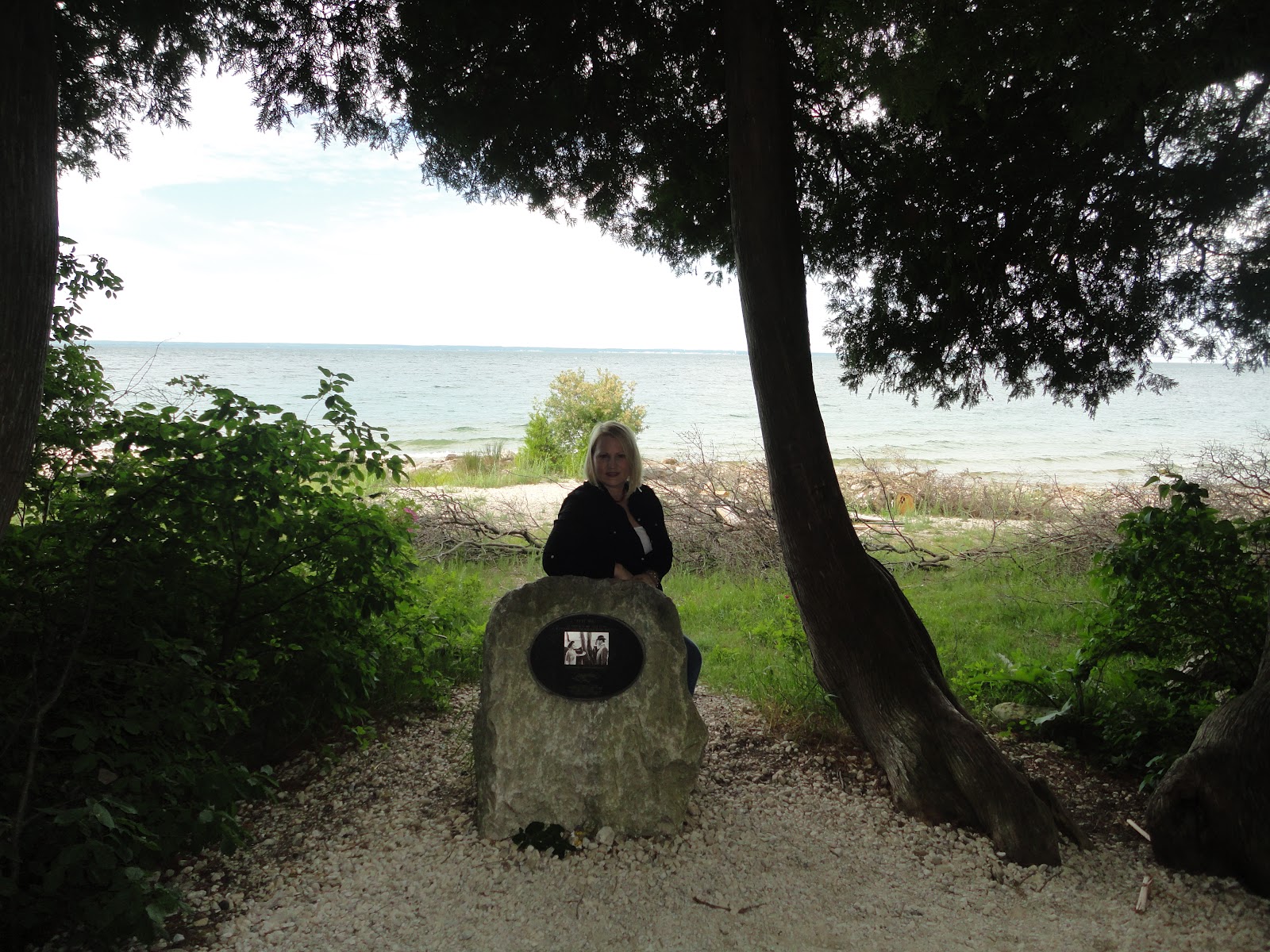
In fact, we loved this movie so much that a few years ago my mom and I took my daughters and traveled to Macinac Island in Michigan (only a few hours from where I lived at the time) to see the Grand Hotel where it was filmed and visit some of the movie's locations. 


(Abigail on the front porch of the very grand Grand Hotel and, below, Abigail and Madeline on the grounds in front of the hotel.)
 

And that's me next to the rock that marks the spot where they met in the movie. 
 

This is a fabulous movie, romantic and heartbreaking, and she is excellent in it. 

#2: War and Remembrance


I grew up watching The Winds of War and it's sequel War and Remembrance. 
In War and Remembrance Jane takes over the role of Natalie Jastrow, an American woman that is Jewish and has been living in Italy with her uncle and working as his assistant. 
In this film she is trying to get her uncle, Aaron, out of Europe. The outbreak of World War 2 traps them both and her son Louis. They try to hide but are caught by the Nazi's and sent to the "Paradise Ghetto", Terezin, and finally to Auschwitz. 
She is really great in this role. It was weird to have the character change actresses for the sequel but she handled it really well. 

#3: Dr. Quinn, Medicine Woman


I started watching Dr. Quinn in my late teens and it was my FAVORITE show for years. 
I loved it so much. And I think Jane was perfect in this. She was sassy and smart and driven and full of heart. 
She played the title character, Dr. Michaela Quinn who defied conventions of the society she lived in by following in her father's footsteps to become a doctor. 
When he died, she left Boston and her wealthy, high-society life to live in the small frontier town of Colorado Springs. The people of the town are not too thrilled to have a woman doctor. 
She has to overcome the prejudices of the town whilst dealing with the unexpected responsibility of raising three orphaned children and a growing relationship with Byron Sully.
Writing about it makes me want to go watch it. 

#4: Austenland, of course


As all of you know, this is one of my favorite movies.
Jane plays Mrs. Wattlesbrook, the prickly and serious owner of Austenland. 
Jane plays this part so straight but with so much humor. She was absolutely perfect for this role. 

*What is your favorite Jane Seymour role?

Monday, July 13, 2015

Let's talk about: Looking for Arthur in the U.K


As I have mentioned before on this blog, I have always been very interested in the legend of King Arthur. This interest was created when I was a young girl and Sword in the Stone was one of my very favorite movies. 
It is no wonder then that through the years there have been many versions of the legend that have caught my attention, such as First Knight and the BBC's Merlin.  
 
Naturally, when I started researching my upcoming trip to the U.K, I was very interested in finding out more about places that factor into Arthurian legend. 
I will not be visiting all of these. But here are my favorites:

#1: Wroxeter in Shropshire


In the countryside just outside of the Shropshire town of Wroxeter, archaeologists have unearthed a vast Roman city. Many believe that it is the ruins of Camelot. 

#2: Mitchell's Fold Stone Circle


Mitchell's Fold is 27 metres in diameter and consisted of 37 stones but only 14 survive today.
This stone circle is also in Shropshire and one of the stones has a strange hole in it that leads to the myth that it is the stone from which Arthur pulled Excalibur.

#3: Glastonbury Tor


This hill is believed to be the ancient Isle of Avalon. The area surrounding it used to be flooded which adds to the belief since it used to be an island. 
There are seven levels of terraces going around the hill. They are believed to be man made and some believe that they were a path for those who have made pilgrimages to the site.  
Glastonbury Tor is also associated with the legend of the Holy Grail. Many believe that Joseph of Arimathea came to Britain with the Holy Grail containing drops of the blood of Jesus Christ. 
When Joseph arrived at the Isle of Avalon, he landed just below the Tor. He thrust his staff into the ground and rested. By morning, his staff had become a thorn bush: The Glastonbury Thorn. 
Joseph buried the Holy Grail just below the Tor. 
Soon after, a spring, now known as Chalice Well, began to flow. It is believed to have healing powers and over the years many have come to Glastonbury Tor to drink from the healing spring.
This relates to King Arthur as well because it is said that finding the Holy Grail was a particular quest of King Arthur and his knights. 
The hill has a 14th century church tower sitting on top. 
The hill is believed by some to contain a secret magical passage to the underworld where King Arthur is sleeping and will awake in England's hour of need to come to her rescue.
 
#4: Glastonbury Abbey


There are MANY places that claim to be Arthur's grave but Glastonbury Abbey is the one I have read about the most. It is said that a Welsh bard gave the location to Henry the 2nd and told him that Arthur was buried in the old graveyard at Glastonbury between two pyramids. 
At seven feet down, they found a stone slab with an inset lead cross. 
At sixteen feet down they found a hollowed out log that contained the skeletal remains of a large man and a delicate woman.
The cross with the words, "Here lies buried the famous King Arthur with Guinevere in the isle of Avalon", has disappeared over time. 
After the grave was discovered in 1190, it was moved by order of King Edward the first to the interior of Glastonbury Abbey in 1278. The Abbey was near destroyed over time but there is a portion of a tomb from the right time period preserved today in the abbey's visitor center. There is a marker that identifies the places as the grave site in the middle of the abbey ruins. 
 
 #5: Tintagel Castle


This is probably one of the most well known locations associated with King Arthur. 
Tintagel Castle in Cornwall is said to be the birthplace of Arthur. 
This was first associated with King Arthur by Geoffrey of Monmouth in his account of British history.  According to one legend, Arthur's father, the king of all Britain, Uther Pendragon, went to war against Gorlois, the Duke of Cornwall. He had fallen in love with the wife of Gorlois, Igraine. 
While Gorlois defended himself against Uther's armies, he sent Igraine to stay safely within Tintagel Castle.  Merlin is said to have changed the appearance of Uther to that of Gorlois so that he was able to get into the castle. And that night Arthur was conceived.
Located beneath Tintagel Castle there is also a cave. It is called Merlin's cave. Tennyson made Merlin's Cave famous in his Idylls of the King, describing waves bringing the infant Arthur to the shore and Merlin carrying him to safety.
There are many myths surrounding Arthur's birth and Tintagel Castle. These are just some of them. 

#6: Dozmary Pool


Dozmary Pool, in Cornwall, is said to have no bottom and an underwater tunnel that connects it to the sea. Archaeologists have found traces of Neolithic artifacts on the shores of the pool.
It is thought to be the home of the Lady of the Lake.
Legend says that before Arthur died from the wounds he received at the battle of Camlann, he asks one of his knights to return Excalibur to the Lady of the Lake. The knight tried twice but couldn't bring himself to throw the sword into the lake. On the third try he finally was able to do it.
When he did, the surface of the water was broken by the hand and arm of a woman who reached out to catch it and it was taken down into the waters.
There is archaeological evidence that the pool was the site of rituals and ceremonies, thought to be tied to ancient pagan deities, where swords were cast into the water as offerings.

#7: The Round Table


In the Great Hall of Winchester, all that remains of the Winchester Castle, in Hampshire, hangs the Round Table. 
According to legend it is the Round Table of King Arthur and his Knights. 
Originally it was a standing table with 12 outer legs and a central support. It is nearly 20 feet in diameter and weighs about 2, 600 pounds. It is made of English Oak.
In the early years of King Henry the 8th's reign, it was painted with the Tudor Rose at the center and is thought to portray Henry as King Arthur on his throne, surrounded by 24 places for his Knights of the Round Table. 
It first was hung on the eastern wall, perhaps being placed there as early as 1348. In 1873, it was moved to its current position on the west wall.

#8: Amesbury Abbey


Recently, Amesbury (near Stonehenge) was given the title of the oldest occupied settlement in Britain. Archaeological excavations have found proof that the site was occupied as far back as 8,820 BC. 
It was first connected to the Arthurian legend in Le Morte d' Arthur by Thomas Malory. 
After Arthur dies, Guinevere retreats to a convent. While this is referenced in many texts having to do with the legend, Malory was the first to specify the name of the convent as being Amesbury Abbey. 
According to this story, Lancelot returned to the abbey after her death to get her body and he buried it beside Arthur at Glastonbury as his final act of penance.

These are just a small selection of locations tied to Arthur. 
Whether you believe in the legend of King Arthur or not, I believe the story and the locations that have been connected to it are fascinating. 

*What are your thoughts on the Arthurian legends?
*Have you been to any of these spots. 
*Which would you be most interested in visiting, if any?